 Book now
 Rietveld beyond the house: the chairs, the buildings and the collection
From the Red and Blue Chair to the Van Gogh Museum, the work of the Utrecht furniture maker who became one of the century's great architects, and where to find it.
The Rietveld Schröder House was Gerrit Rietveld's first building, and for many people it is the only one they know. But Rietveld worked for another forty years after it was finished, and his career runs from hand-made furniture in a Utrecht workshop to housing estates, exhibition pavilions and one of the most visited museums in Europe. This guide follows that career through the pieces you can still see, and ends at the Centraal Museum in Utrecht, which holds more of his work than anywhere else.
A furniture maker first
Rietveld was born in Utrecht in 1888 and trained in his father's furniture workshop. He taught himself drawing, painting and model-making and, from 1906 to 1911, worked as a draughtsman for a Utrecht jeweller. By 1917 he had opened his own furniture workshop.
His early pieces were not about craftsmanship for its own sake. Rietveld hoped that much of his furniture would eventually be mass-produced rather than made by hand, and he aimed for simplicity of construction: standard boards and battens, joined in ways that a capable craftsman could repeat. That thinking, cheap and clear construction, runs through the rest of his career.
The Red and Blue Chair
The Red and Blue Chair is the object that made Rietveld's name. He designed it around 1917 and 1918 as a frame of unstained wood, with a flat back and seat resting on a grid of thin battens. Each piece keeps its own identity: the battens run past one another and stop just beyond the joints instead of meeting flush.
In the early 1920s the chair was given the colours that named it: a black frame with yellow ends, a red back and a blue seat. It became one of the first three-dimensional statements of De Stijl, the Dutch movement Rietveld had joined, and one of the most famous chairs of the twentieth century. Rietveld never fixed an authoritative set of measurements or colours, which is one reason several versions exist in collections around the world.
Seen next to the house, the chair is an obvious rehearsal. Like the chair, each component of the house has its own form, position and colour.
The house as a turning point
With the Rietveld Schröder House, built with Truus Schröder in 1924, the furniture maker became an architect. The house was an experiment and a manifesto at once, and it quickly drew international attention. But commissions were slow to arrive. As Rietveld himself put it, a true creation comes into conflict with the demands of the period before it.
Rietveld and Schröder ran their architectural practice from the ground floor of the house, designing interiors and houses for private clients. Their joint projects included a glass radio cabinet and a hanging glass cabinet in the mid-1920s, and interiors for her family in Amsterdam.
Leaving De Stijl, and the Erasmuslaan houses
In 1928 Rietveld broke with De Stijl and moved towards the more functional architecture known in the Netherlands as Nieuwe Bouwen or Nieuwe Zakelijkheid. The same year he joined CIAM, the international congress of modern architects. From the late 1920s he was concerned with social housing, cheap production methods, new materials, prefabrication and standardisation; in 1927 he was already experimenting with prefabricated concrete slabs.
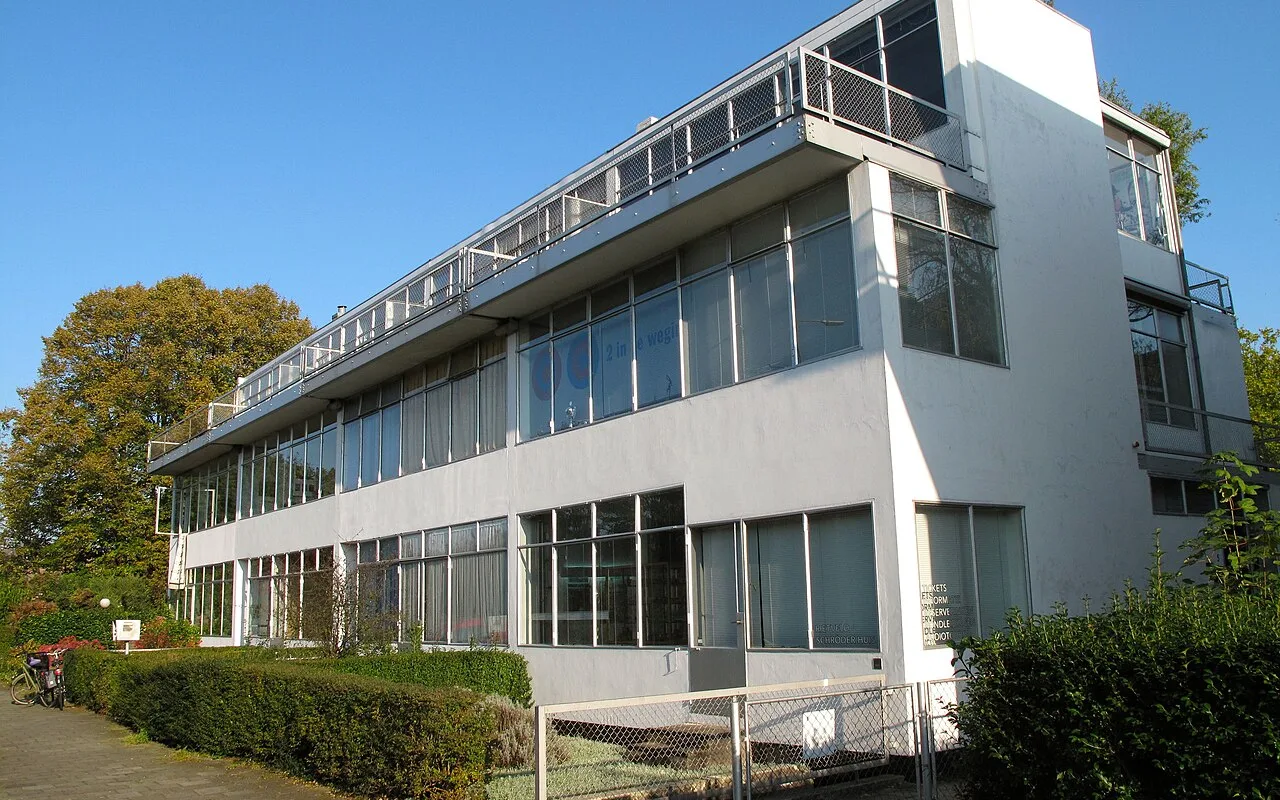
You can see the shift without leaving Prins Hendriklaan. Across the street from the house stands the apartment block on Erasmuslaan that Rietveld and Schröder designed together in the early 1930s, a long, white, flat-roofed building with continuous bands of glass. It is the view from Schröder's windows, and she lived there herself for a time before moving back into the house in 1936. It is private housing, so admire it from the pavement.
The Zig-Zag Chair
Rietveld kept designing furniture all his life. The best-known piece of his later years is the Zig-Zag Chair, designed between 1932 and 1934. It has no legs at all: four flat wooden boards joined in a Z-shape with dovetailed and bolted or screwed joints. Where the Red and Blue Chair is a grid of separate parts, the Zig-Zag is a single folded line. It is still made under licence today.
Housing, academies and pavilions
For a long time all of Rietveld's commissions came from private individuals. Only in the 1950s was he able to put his ideas about social housing into practice, in projects in Utrecht and Reeuwijk.
His reputation revived after 1951, when he designed a retrospective exhibition about De Stijl that travelled to Amsterdam, Venice and New York. In 1958 the Centraal Museum in Utrecht gave him his first retrospective devoted to his architecture. The commissions that followed included the Dutch pavilion at the Venice Biennale in the 1950s, the art academies in Amsterdam and Arnhem, and a press room for the UNESCO building in Paris. In 1961 he formed a partnership with the architects Johan van Dillen and J. van Tricht, which built hundreds of homes, many of them in Utrecht.
One small building is especially loved. In 1955 Rietveld designed a pavilion for an international sculpture exhibition in Sonsbeek Park in Arnhem to show small sculptures. It was rebuilt in the sculpture garden of the Kröller-Müller Museum in 1965, and rebuilt again with new materials in 2010.
The Van Gogh Museum
Rietveld's most visited building is one he never saw finished. He began the design of the Van Gogh Museum on the Museum Square in Amsterdam, and the building was completed after his death. It opened on 2 June 1973, and its buildings are credited to Gerrit Rietveld and Kisho Kurokawa.
If you are combining Amsterdam and Utrecht on one trip, it is a neat pairing: the first building of Rietveld's career in a quiet Utrecht street, and his last major work at the heart of Amsterdam's museum quarter.
Recognition after his death
Rietveld died in Utrecht on 25 June 1964. Four years later, when the art academy in Amsterdam was given the status of an academy for fine arts and design, it was renamed the Gerrit Rietveld Academie in his honour. Truus Schröder spent the years after his death assembling his archive, the work she considered her life's task. His son Wim Rietveld also became a well-known industrial designer.
The Centraal Museum: the largest Rietveld collection
To see Rietveld's furniture in one place, go to the Centraal Museum in Utrecht, at Agnietenstraat 1 in the old centre. It holds the largest Rietveld collection in the world: more than 250 furnishings and other objects, including mock-ups and scale models. Its permanent collection, Collection Centraal, always shows iconic chairs, drawings and models by Rietveld, together with archival material relating to the Rietveld Schröder House, and the museum regularly organises temporary exhibitions about his work.
The same museum manages the Rietveld Schröder House itself and the complete Rietveld Schröder Archive, around 2,000 drawings, 2,000 photographs and 3,800 letters, nearly all of it digitised and available online. The Centraal Museum is open Tuesday to Sunday from 11:00 to 17:00 and needs its own ticket, separate from the house.
A Rietveld day in Utrecht
The simplest way to see Rietveld beyond the house is to combine the two in one day. Start at the Centraal Museum when it opens at 11:00 and spend an hour with the chairs and models, so your eye is trained on how his pieces are put together. Then take a bus or bike east to Prins Hendriklaan for an afternoon slot at the house. Afterwards, cross the street to look at the Erasmuslaan apartments from outside, and you will have seen the furniture, the first building and the turn to modern housing in a single afternoon.
How to look at a Rietveld chair
Whether you see his chairs at the Centraal Museum or in photographs, a few things are worth looking for. First, the joints. In the Red and Blue Chair the battens cross and run past each other instead of meeting in a flush corner, a type of joint now often called a Rietveld joint. Each part is held in place but stays visibly separate.
Second, the relationship between load and support. In the Red and Blue Chair the back takes the weight of the sitter and also supports the arms, and the distinction between what carries and what is carried is deliberately blurred. Rietveld even asked the craftsmen who built it to attach a verse by the German poet Christian Morgenstern under the seat.
Third, the colour. On the painted versions, the black frame recedes and the coloured planes seem to float, which is why the chair appears almost transparent against a dark background. Once you have seen that effect, look for it again in the house, where the coloured lines on the façade sit against white and grey in the same way.
Rietveld's chairs in the house
The house and the furniture belong together. Rietveld was a furniture maker before he was an architect, and many of the fittings in the house were designed with Schröder as part of the building. A version of the Red and Blue Chair was later placed in the house itself, where its black frame almost disappears against the dark floor and the coloured planes seem to hang in the air. Seeing the chair and the rooms together makes the connection between them easy to grasp.
Frequently asked
What is Gerrit Rietveld most famous for?
The Red and Blue Chair, designed around 1917 to 1918, and the Rietveld Schröder House, built with Truus Schröder in 1924 and a World Heritage Site since 2000. He also designed the Zig-Zag Chair and began the Van Gogh Museum in Amsterdam.
Where is the largest collection of Rietveld's work?
At the Centraal Museum in Utrecht, which holds more than 250 Rietveld furnishings and objects. Its permanent collection always shows chairs, drawings and models by him.
Did Rietveld design the Van Gogh Museum?
He began the design, and it was completed after his death in 1964. The museum opened in 1973, and its buildings are credited to Rietveld and Kisho Kurokawa.
Can I see other Rietveld buildings near the house?
Yes. The apartment block on Erasmuslaan, directly across the street, was designed by Rietveld and Truus Schröder in the early 1930s. It is private housing, so view it from outside.
When did Rietveld leave De Stijl?
In 1928. He moved towards the functional architecture known as Nieuwe Bouwen, joined the international CIAM congress the same year and turned to social housing, prefabrication and new materials.
Is the Red and Blue Chair on display in the Rietveld Schröder House?
A version of the chair was placed in the house, and the Centraal Museum's permanent collection always shows Rietveld chairs. If a particular piece matters to you, check the museum's current displays before you travel.